Foundey · Senior Product Designer · September 2026
Fifty minutes to answer it.One night to build it.
The brief asked for a low-fidelity redesign of a warehouse operations dashboard, in under an hour. The hour went into the argument. Then the build ran overnight, unattended, against eleven gates that grade themselves — and not one screen was drawn by hand.
50 min
Scaffold to a live URL
12:05 → 12:55, day one
12
Commits with nobody awake
22:20 Mon → 13:07 Tue
635
Automated checks
283 unit · 304 end-to-end · 48 pixel
11
Quality gates
Nine of them a single command
0
Screens drawn by hand
The Figma files are generated
The ask
Two sentences, from two people who cannot see each other.
The brief gave a fulfillment centre, a dashboard nobody trusts, and two complaints. Everything below is an answer to one of them.
“I never know what needs my attention first.”
“I cannot see what each worker is doing.”
- Under 1 hour
- Low fidelity or wireframes
- Graded on product thinking
The diagnosis
The old screen already ranked. Ranking was never what was missing.
Its queue was titled “Needs Your Attention, ranked by urgency”, and people still said they did not know what to do first. So the order was not the problem. Four other things were.
01 · Ranked by urgency
It ranked, but never said why.
A number nobody can see is a number nobody trusts. The score was real and invisible, so the order read as arbitrary.
02 · Grouped by source
It sorted by where a task came from.
System, safety, vendor, escalation. None of those is a reason to act. What happens next is.
03 · Four identical buttons
Every row asked for attention at once.
When a screen shouts uniformly, the loudest thing on it is noise, and the ranking underneath stops meaning anything.
04 · An endless feed
There was no way to be done.
A queue that never empties gives a shift no shape. Nobody can pace work they cannot see the end of.
The answer
One thing at the top, and the reason written underneath it.
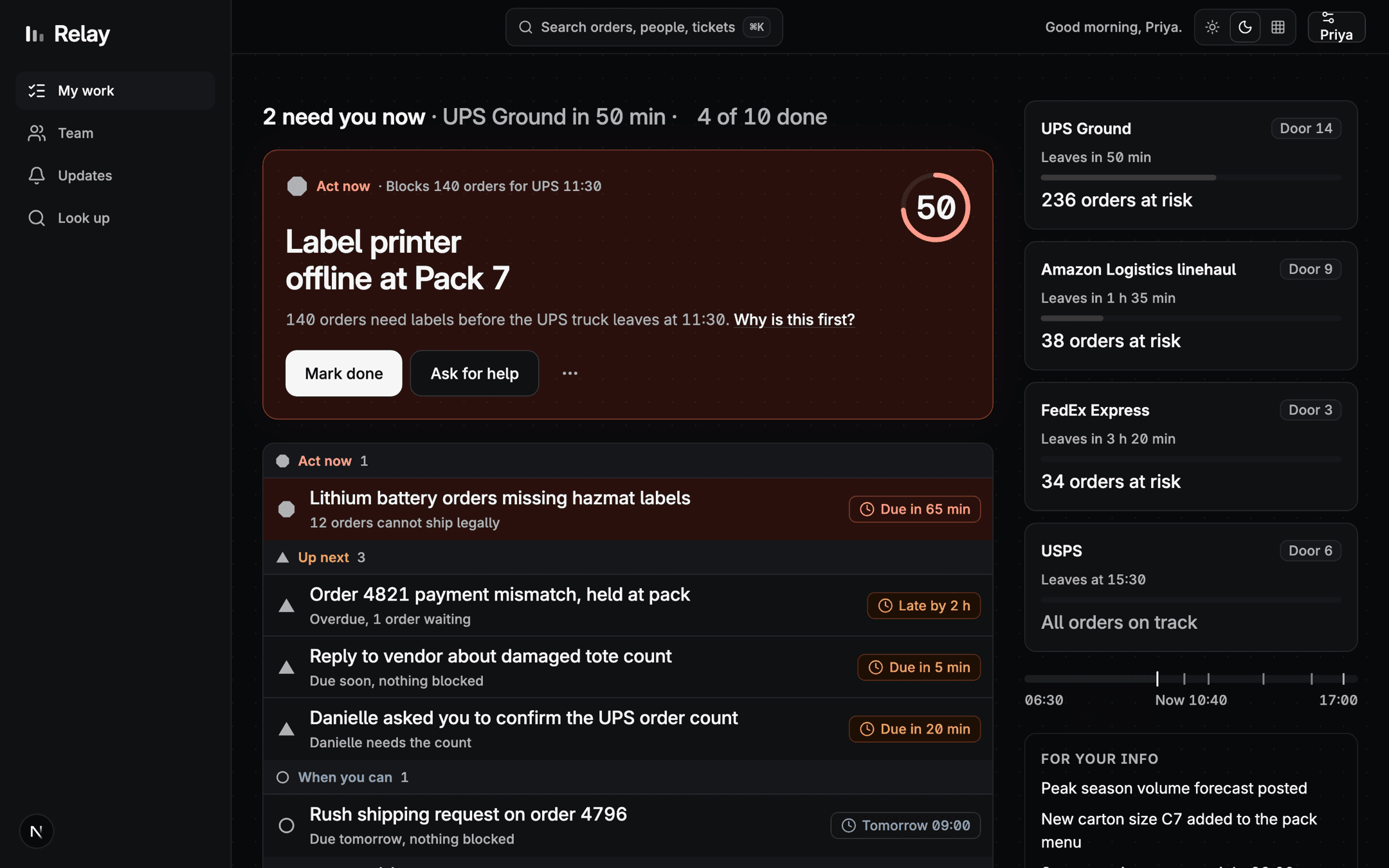
Not a better sort. A screen that commits to a single next action, says out loud why that one, and can be finished.
The score, in plain words
“Why is this first?” opens the actual arithmetic. Not a confidence bar, not a coloured dot — the three numbers that produced the rank and the threshold they crossed.
Four tiers, instead of a feed
Grouped by what happens next, never by where the task came from. The tier name is the instruction.
- Act nowScore 60+. Someone is blocked, or a truck is.
- Up nextScore 40–59. It becomes Act now if it waits.
- When you canScore 20–39. Real work, no clock on it.
- For your infoUnder 20. Read it, do nothing.
And a way to be done
Finish the last one and the queue does not refill itself. It says the shift is clear and shows what was finished. A queue with no end has no pace.
The proof
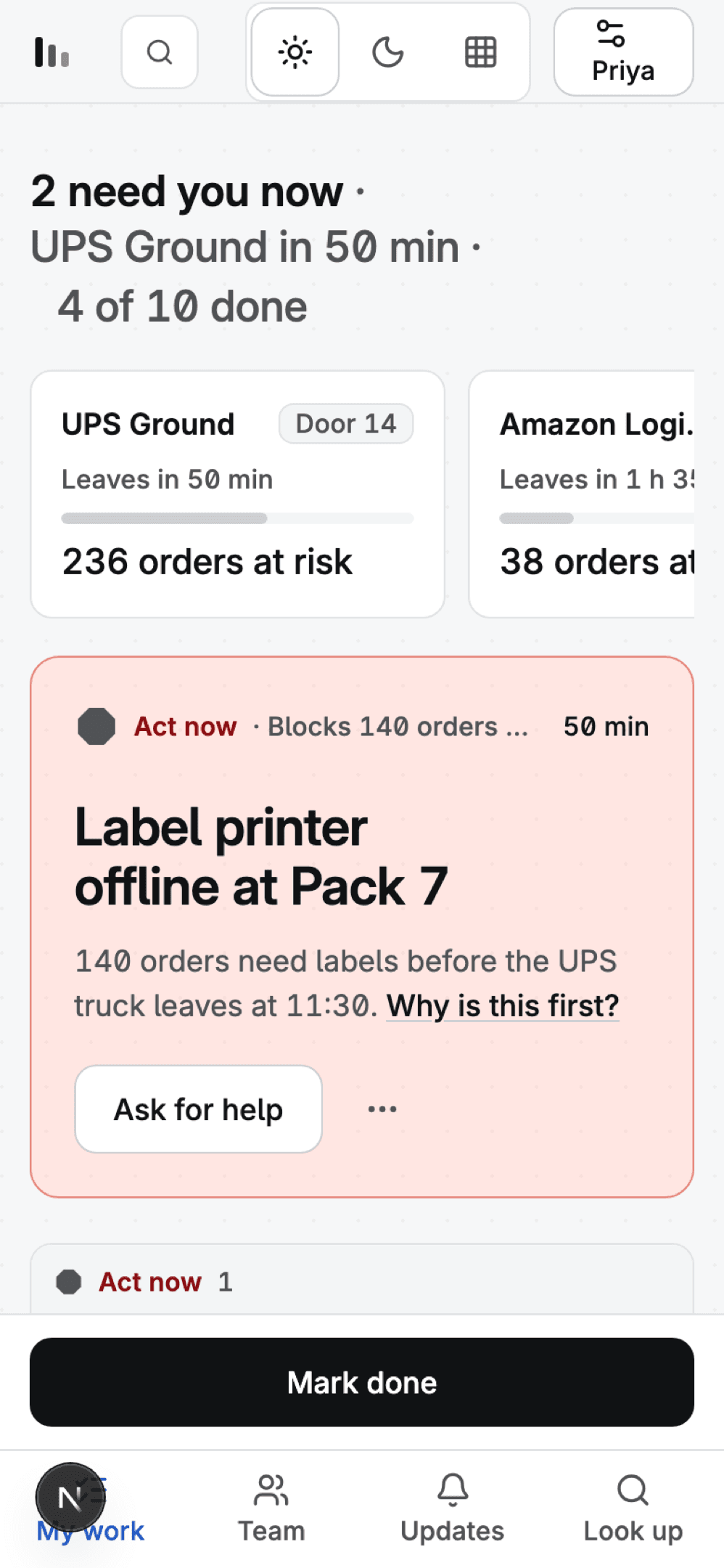
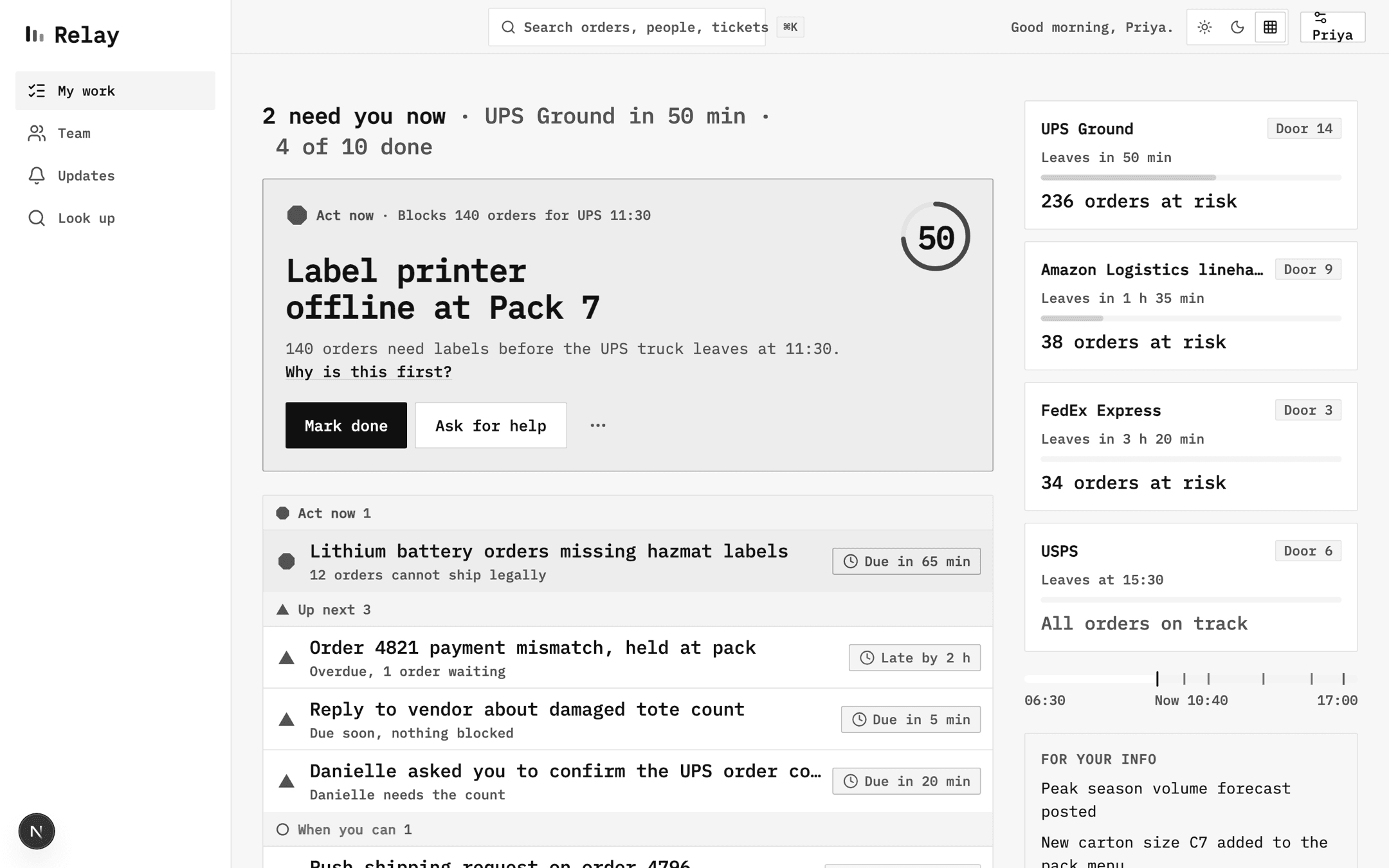
If the ranking only works in colour, it does not work.
Wire is a real mode with its own token values — every chroma channel multiplied by zero, lightness untouched. It is not a grayscale filter, and a lint rule keeps it that way. Switch it and check that you can still tell what to do first.
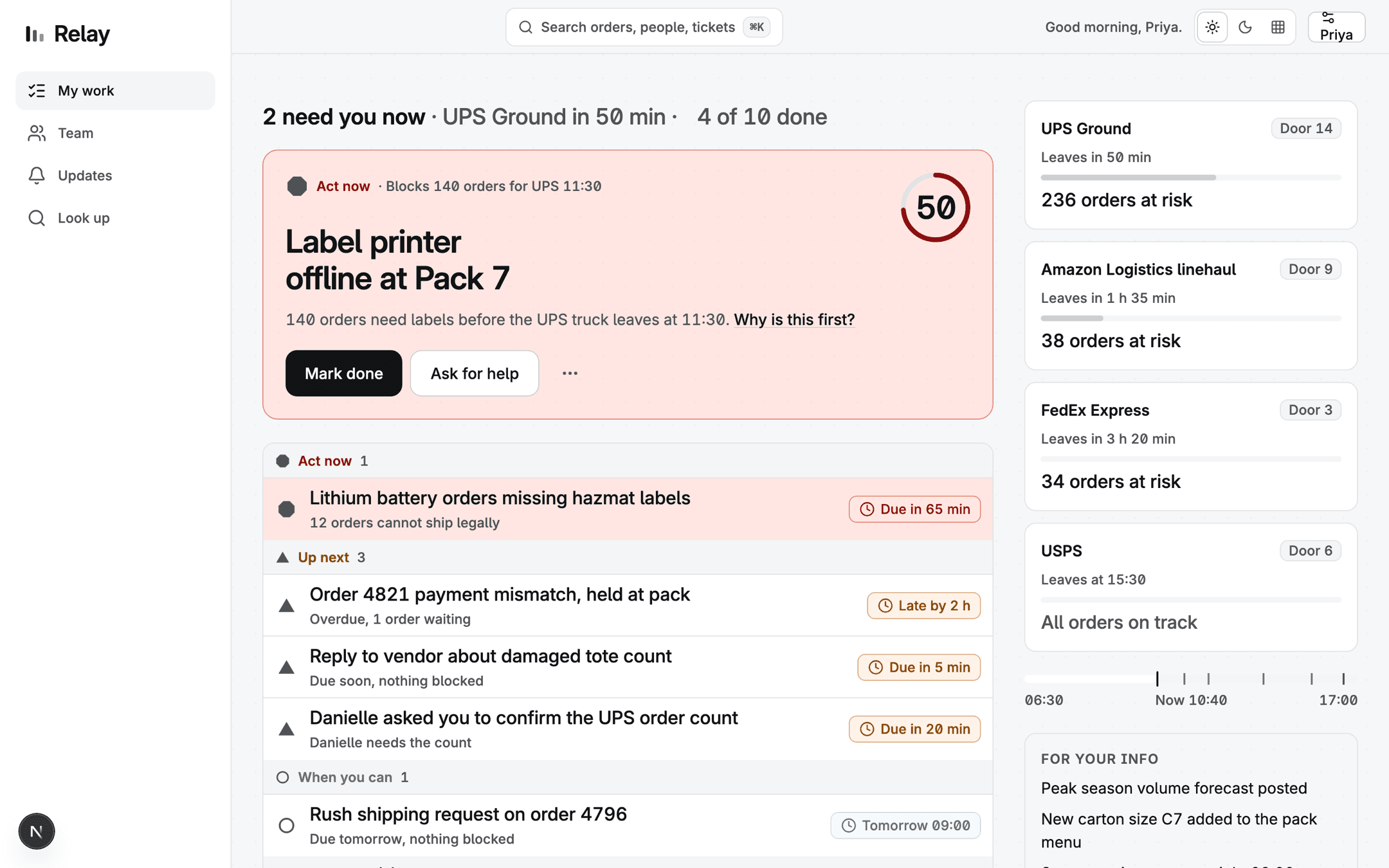
Hi-fi. Tier tint, tier hue, tier weight.
This is also the brief’s low-fidelity answer, kept live instead of screenshotted: the same shipped screens, with every colour channel switched off. Rank survives in shape, label, position and weight.
The process
I wrote the argument and the gates. The night shift wrote the code.
Transcribed from git log, in the machine's own time zone. Twelve commits landed between the last instruction of one night and lunchtime the next day. Six of them arrived between midnight and half past eight.
- A person decided something
- An agent shipped something
12:05
Mon 22
The brief lands. The hour starts.
Scaffold, tokens, seed data, and a priority model with its own tests.
12:55
Mon 22
A deployed prototype, 50 minutes in.
Two screens, a ranked queue, wireframe mode, and a production URL. That is the answer to the brief as written.
15:00
Mon 22
A second session reviews the first, and it does not go well.
Measured, not eyeballed: the main column was narrower at 1024 than at 1440, the undo toast never appeared on screen, and wireframe mode hid its own off switch.
16:07
Mon 22
Start again on Next 16, with a plan and eleven gates.
The product argument survives. The execution does not. Nothing advances a phase without a green gate.
22:20
Mon 22
Last instruction of the night.
The test loop is made cheap to run and cheap to read, so that a long unattended run does not drown in its own output.
23:18
Mon 22
Foundations: type, colour and geometry tokens.unattended
One source of truth for every value the screens are about to be built from.
01:11
Tue 23
The worker screen.unattended
Hero, the reason underneath it, the openable score, four tiers, and a finish line.
02:46
Tue 23
The manager board.unattended
Exceptions first. Four tiles that filter. Never a stopwatch on a person.
05:28
Tue 23
Updates, search, and the ends of the day.unattended
All-clear, end of shift, and the empty states that make a queue finishable.
10:33
Tue 23
Motion: fourteen moments, each with a reduced-motion variant.unattended
The done choreography first, because it is the one people will see a hundred times a shift.
13:07
Tue 23
The deck. Twelve commits since the last instruction.unattended
Part A is the one-hour answer in ten slides. Part B is marked Optional on every slide.
14:11
Wed 24
An independent session reviews it and finds seven real defects.
A session that built none of it drives every route at three widths. It also catches that the first fix for one of them was itself wrong, and says so in writing.
17:24
Wed 24
Ship.
Every gate re-run against the deployed URL, not against a local build.
My own hours went into four things: the argument, the plan, the constraints, and reading the reviews. Each session got a short brief and a hard exit condition. What made that safe was not trust — it was that every claim a session makes is checkable by a command someone else can run.
The constraints
Nothing is graded by looking at the thing it grades.
Eleven gates. Nine are a command, so they cannot be talked out of a red. The last two are judgement, and are done by a session that did not build the thing.
- G1command
Every colour resolves to a token. No literal hex outside one file
- G2command
Controls sharing a row share a height. Every touch target ≥44px
- G3command
Six widths render every surface with no scroll, overlap or clipping
- G4command
Zero axe violations on every route in all three modes. AA on every pair
- G5command
With colour removed, the ranking is still recoverable
- G6command
Every animation has a reduced-motion variant. Nothing loops
- G7command
Clocks and greetings are identical in three time zones
- G8command
Lighthouse ≥95 for performance and accessibility, median of three
- G9command
Verb-first buttons, no orphaned labels, grade ≤8 reading level
- G10judgement
Each Figma file matches what shipped, verified by screenshot
- G11judgement
A session that did not build it drives every route and writes the review
What the gates cost to run
- 283 unit tests
- 0.5s — the priority model, copy, tokens, contrast pairs
- 304 end-to-end tests
- 78s — size contract, six widths, axe, wire, reduced motion
- 48 pixel baselines
- 10s — eight surfaces at six widths, compared not described
The honest part
What I did not do.
A case study that only lists wins is a sales page. These are the choices a reviewer would find anyway by opening the repo, so they are here first.
- 01
I did not draw a single screen in Figma.
The three Figma files exist, and they were built last, generated from the shipped code and its tokens. A design system maintained by hand in two places drifts within days. This one has a direction.
- 02
I did not polish pixels.
Not one spacing value was nudged by eye. Every height, radius and colour is a token with a test behind it, so when something looks wrong the rule is wrong — and fixing the rule fixes every screen at once.
- 03
I did not do research.
There are no users here. The two personas, the site, the carriers and the cutoffs all come from the brief and from one frozen Tuesday at 10:40. No data is invented at runtime.
- 04
I did not sit and watch it build.
My own time went into the argument, the plan, the gates and the reviews. The longest stretch of work in this repo happened between 22:20 and 13:07 while nobody was at the keyboard.
- 05
I did not finish everything, and the repo says so.
The demoted hero does not animate back into its row. Reduced motion collapses globally instead of per moment. /team scrolls sideways below 390, a width the app does not claim. Each one is written down where it happened rather than quietly left out.
Go and look
Everything here is running, not rendered.
Four surfaces, a deck, a design system read out of its own stylesheet, and the repository behind all of it.
The product
The worker's screen
One thing at the top, the reason under it, four tiers below. Press E to finish it, ⌘K for anything else. Demo controls are in the top bar.
The product
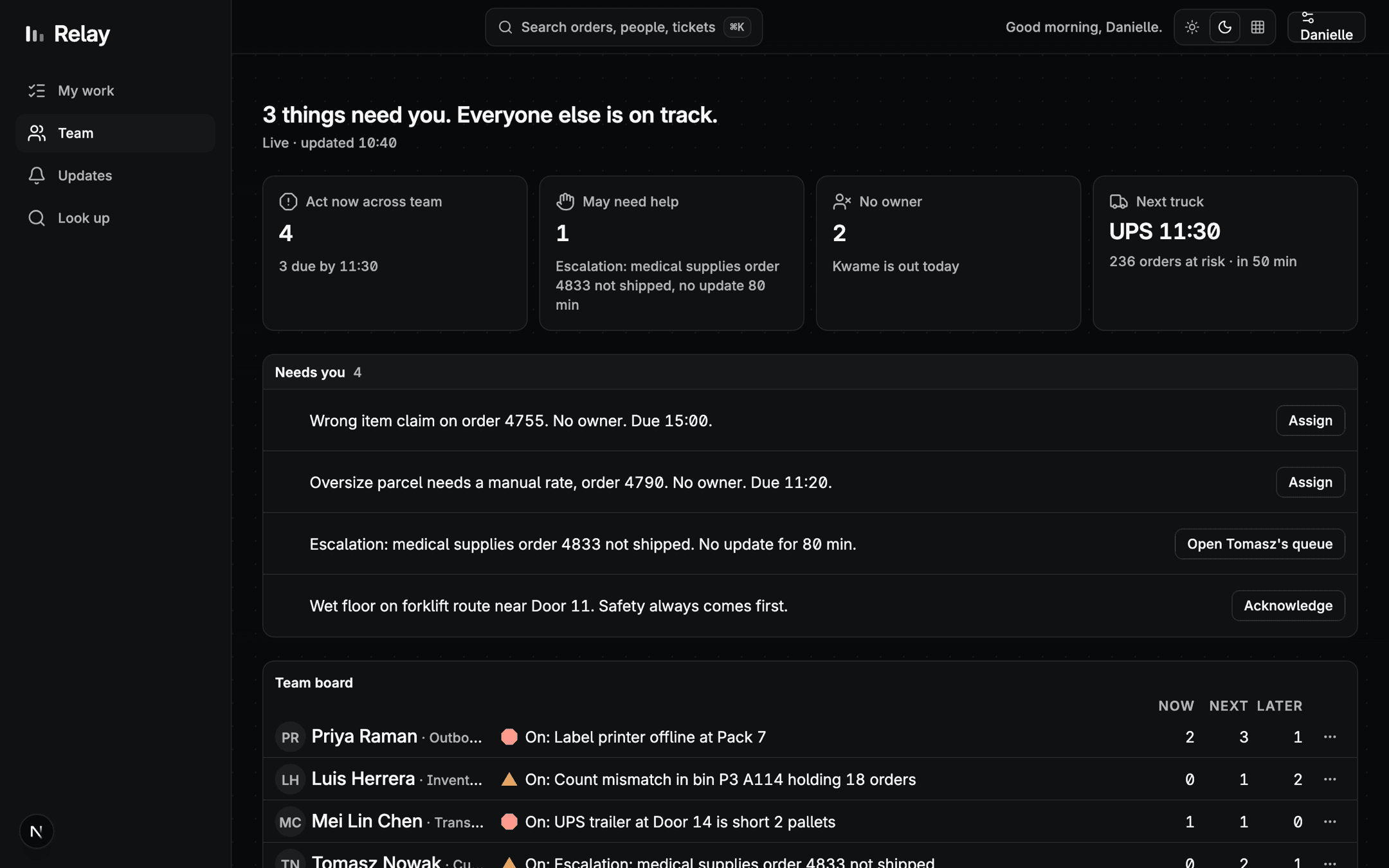
The manager's screen
Exceptions before roster. Four tiles that filter to what needs a decision, then who is already on what.
The system
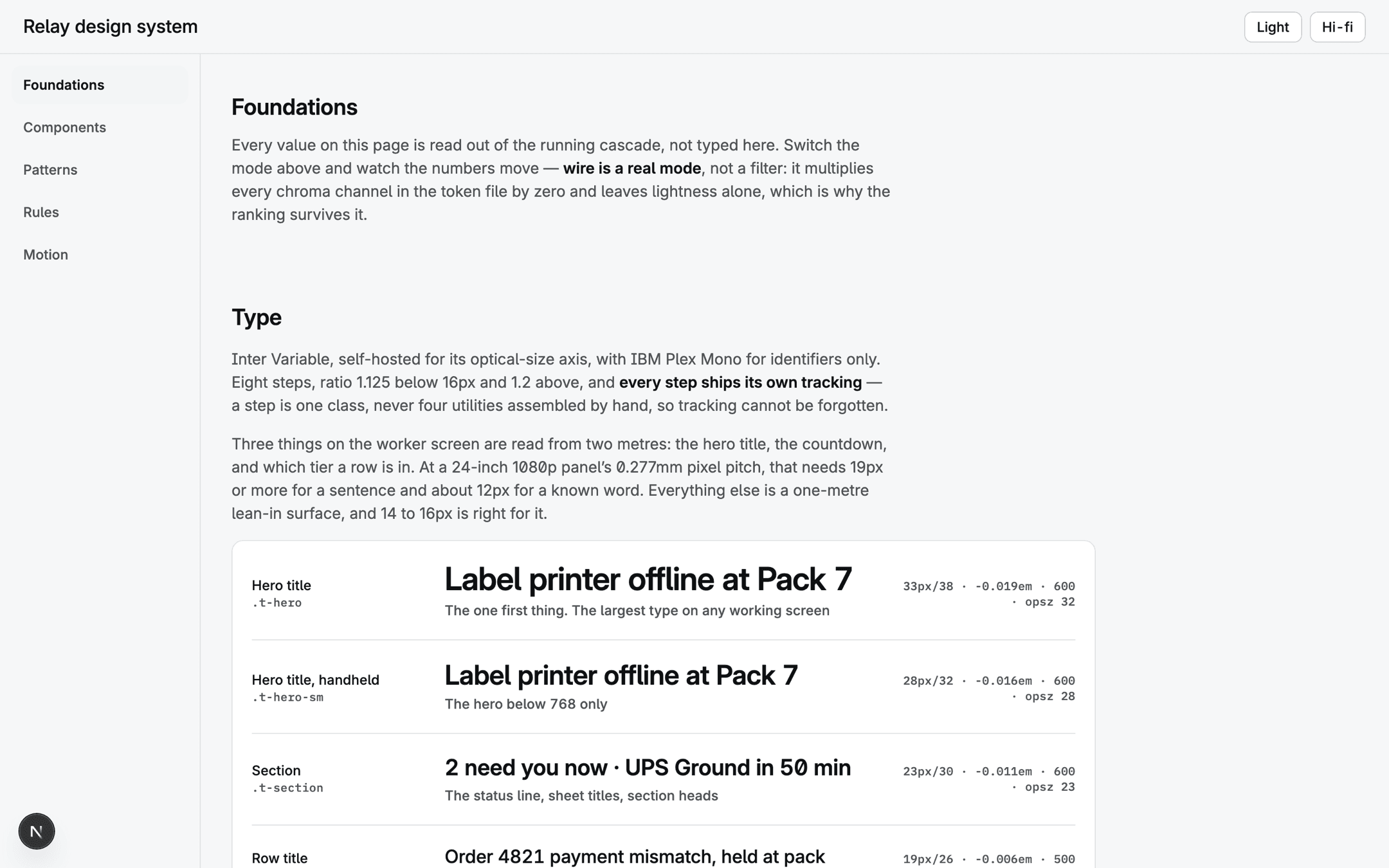
The design system
Foundations, components, patterns, rules and motion — every value read out of the running cascade, not typed by hand into a page about itself.
The argument
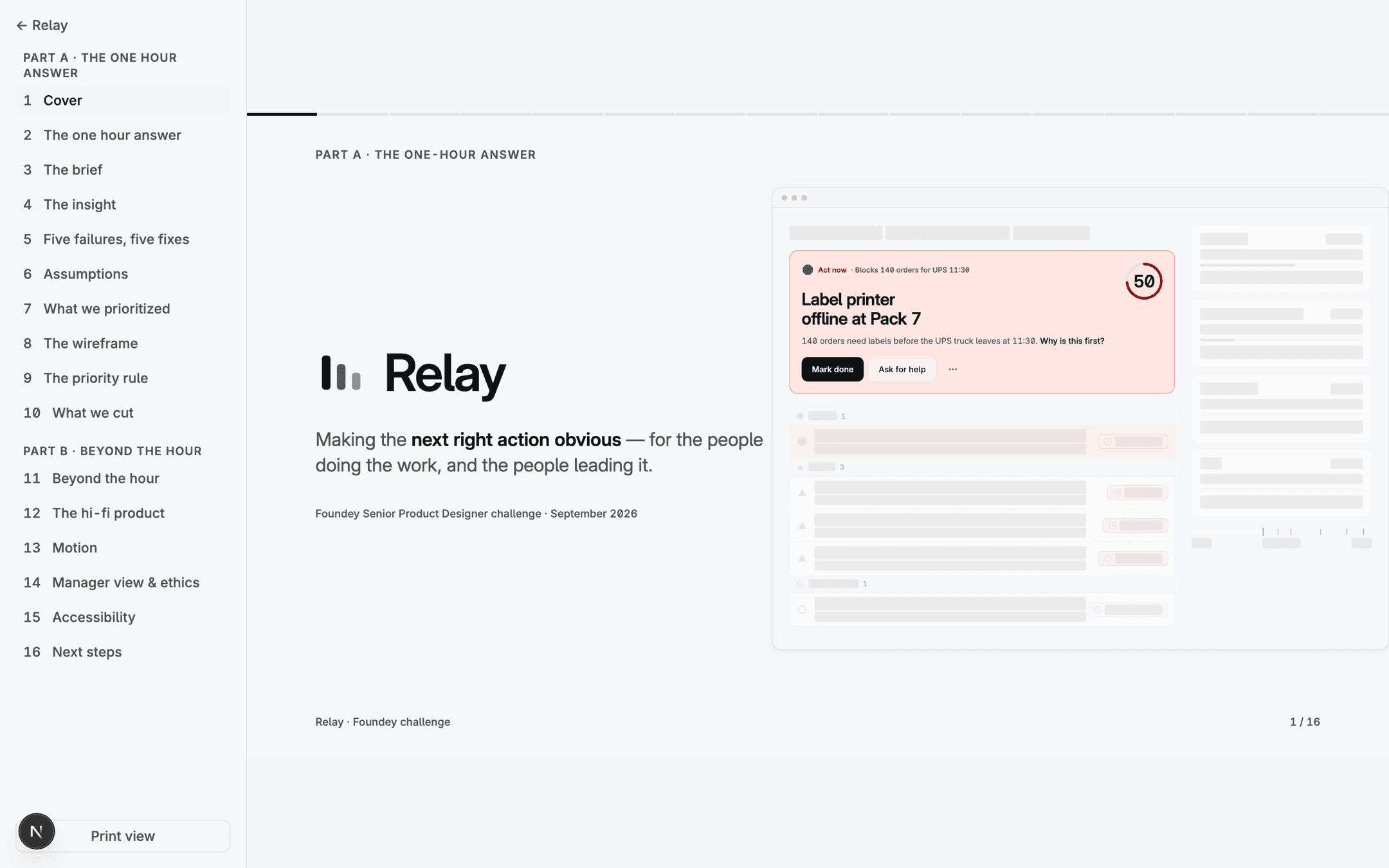
The deck, in sixteen slides
Part A is the one-hour answer. Part B is everything past it, labelled Optional on every slide. Arrow keys move.
The Figma files
Generated from the shipped screens and their tokens, after the fact — variables in three modes, every component a variant set, and eight flows runnable in presentation mode.
The repository
The plan, the gates, the tests, the pixel baselines, and this page. The commit messages are the log the timeline above was read from.